
Doodles in Motion™
Creative Explainer videos for Complex Problems
Sometimes, you need a video or animation to explain a complex concept and bring your story to life.
Doodles in Motion™ is our explainer video and whiteboard animation service, featuring talented teams of experienced animators and artists.
LEARN MORE about our video production process.
Top 10 Questions to ask your client or team before creating an explainer video.

Alphachimp's Doodles in Motion™ explainer video service is led by Peter Durand — artist, educator, and founder of Alphachimp LLC. Peter's hand-drawn visual communication work spans healthcare, science, education, and emerging technology. Clients have included medical researchers, scientists, engineers, and community health organizations across the US. Adjunct professor, Northwestern University Pritzker School of Law, Chicago. Based in Houston, Texas.
Our Explainer video Production Process
Each animation follows the same basic process to get produced on time and within budget:
Concept
Script
Storyboard
Illustration
Animation
Final Video
The key drivers of production budget are the length of your script and the style of animation.
The Style
Style plus substance determines impact.
You are most likely familiar with the animated whiteboard videos. Unlike other producers, our whiteboard videos are highly illustrative, featuring well-drawn characters and attention to detail. (See example video: Harvard University)
We have also been producing more 2D flat art style animation, with more characters and sets to demonstrate concrete events and technologies. (See example video: Electronic Health Records)
STEP 1: Concept
What is the Big Idea?
This is the stage where we collectively walk through the content you have, the audience segment you are targeting, and possible storylines, metaphors, characters, visual models, etc.
This can be helpful before the script stage or in parallel, as it determines the tone and character of the voiceover.
Then we will send a Concept Brief describing the illustration style, the narrative structure, the larger model or metaphor, and the plan for execution.
STEP 2: Script
What is the story you want to tell?
This is what drives the whole project and determines the final production timeline and budget.
Here is a basic calculation we find helpful in determining the length of script:
1-minute = 130 words
2-minute = 260 words
3-minute = 390 words
4-minute = 520 words
5-minute = 650 words
This online calculator is pretty accurate: http://www.speechinminutes.com/
Once we know the script length, we calculate the number of hours our team needs for illustration, creative direction, animation, video editing, etc.
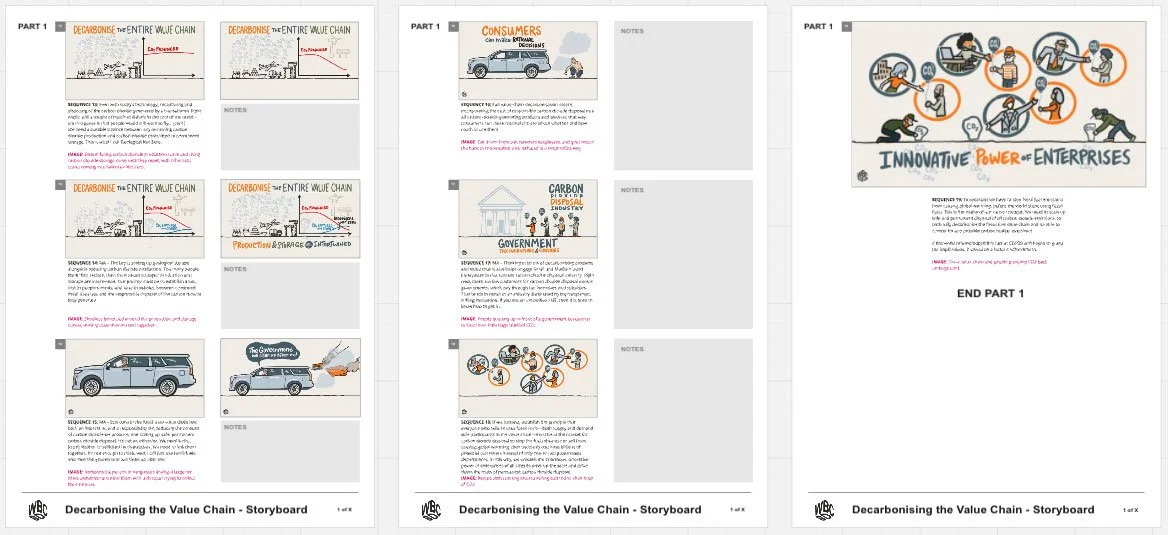
STEP 3: Storyboards
For the standard project, we produce two versions: (1) a rough pencil version to block out scenes and characters, followed by (2) a detailed storyboard with close-to-final artwork.
STEPS 4-6: Final Production
We schedule a call with you to review each version.
After we receive a green light, we move to the final illustration and animation. We will produce a couple of draft video proofs along the way to ensure that everything is in line with the script and concept. Then upload a final video that your team can download to post online or use in a presentation.
TIMELINE
We will build a timeline together.
We aim to produce these in 3-4 weeks, but this also depends upon managing the approvals and edits on the client side. One of our requests is that you appoint a single Client Project Lead to collect all changes and manage the process on your side. This prevents incoming messages from multiple parties and misalignment of expectations, context, and project knowledge.
BUDGET
Everyone's favorite question!
Each project is different, but they all start with a $2500 deposit and scale from there, based upon style and length.
The average 1-3 minute explainer video runs between $3500 - $20,000 when we produce them from concept to completion. Much depends upon where your team is in the development of the story and how complex the final illustration and animation sequences will be.
If you are starting from the beginning, and need help getting started before committing to a full animation, we offer a 90-minute Concept Meeting to get all of the ideas out and draft an initial Design Brief for $500.
Top 10 Questions QUESTIONS TO GET YOU STARTED with creating an explainer video
Here are the Top 10 Questions you should ask yourself—and your team—to help develop the goals for your explainer video, define their target audience, shape the story, and determine the visual style:
1. What is the primary goal of the explainer video?
Consider whether the video is intended to educate, inform, entertain, persuade, or solve a specific problem. Defining the goal helps shape the entire project.
2. Who is the target audience for the video?
Describe the ideal viewer, including demographics, interests, pain points, and any specific characteristics that define your audience.
3. What key message or information do you want to convey?
Identify the core message or takeaway you want the audience to remember after watching the video.
4. What problem does your product or service solve?
Clearly articulate the problem your offering addresses, as this will be a central theme in your script.
5. What sets your product or service apart from competitors?
Highlight the unique selling points or features that make your offering stand out in the market.
6. What tone or mood do you want the video to convey?
Decide whether the video should be humorous, serious, authoritative, or friendly, as this influences the script and visual style.
7. What are the key elements or steps in your message that need visual representation?
Pinpoint the moments in your script that would benefit from visuals, such as charts, graphs, or product demonstrations.
8. Are there any specific brand guidelines or visual preferences you want to maintain?
Share your brand's colors, fonts, and design preferences, ensuring the video aligns with your brand identity.
9. What is the ideal video length?
Determine whether you want a brief 30-second video or a longer, more detailed explanation. The length should align with your audience's attention span and the complexity of your message.
10. How will you measure the video's success?
Define clear metrics for success, such as increased website traffic, higher conversion rates, or improved brand awareness.
This will help evaluate the video's effectiveness once it's released. In the end, be very clear as to your Call To Action (CTA). For example, “Click here to get started!” or “Contact us for a live demo.”
Are you ready to start the process?
Contact Us
Have a Project Request or Question?
Use the form to the right and send us a message ==>
CLICK HERE to schedule a FREE Discovery Call or to book a 1:1 Coaching / Working Session.
Alphachimp, LLC is based in Houston, Texas USA and provides animation, illustration, and graphic facilitation services to clients worldwide.